

Server Authoritative vs Client Authoritative in Modern Multiplayer Game Development with Fish-Networking
Building a multiplayer game in Unity always brings you face-to-face with the ultimate architectural question: who do you trust? In the early days of game development, letting the client dictate what happened on screen was the path of least resistance, but it opened the floodgates to rampant cheating. Today, modern developers rely on robust networking libraries to strike a delicate balance between ironclad security and buttery-smooth gameplay.
When you choose a server-authoritative model, the server validates every player action centrally. However, this security does not come for free. If you move every computation and movement check to the server, server costs and network traffic rise sharply while introducing noticeable lag. This is where modern netcode frameworks and clever hosting strategies become your secret weapon.
For Unity developers, Fish-Networking has emerged as a game-changer. FishNet is server authoritative by design by allowing the use of dedicated servers, but does permit users to act as server and client, giving you the flexibility to implement client-side prediction to mask latency. To further combat lag, authoritative servers can be placed strategically in areas with high player density to lower overall latency for all participants. For example, if you are targeting gaming audiences in Asia, hosting your servers in Tokyo or Hong Kong ensures that your authoritative checks do not ruin the player experience. Let's dive deep into how these two authoritative models work and how you can configure them in Fish-Networking to build a secure, responsive multiplayer game.
- Server-authoritative models establish the server as the absolute source of truth, preventing cheating but increasing server costs and network traffic.
- Client-authoritative models offer instant local responsiveness and lower hosting fees but are highly vulnerable to client-side manipulation.
- Fish-Networking is server-authoritative by design, offering dedicated server support alongside advanced client prediction to mask latency.
- Strategic server hosting in high-density regions, such as Tokyo or Hong Kong for Asian markets, is crucial to maintaining low-latency authoritative gameplay.
Who Rules the Game State? Deciding Between Client and Server Authority
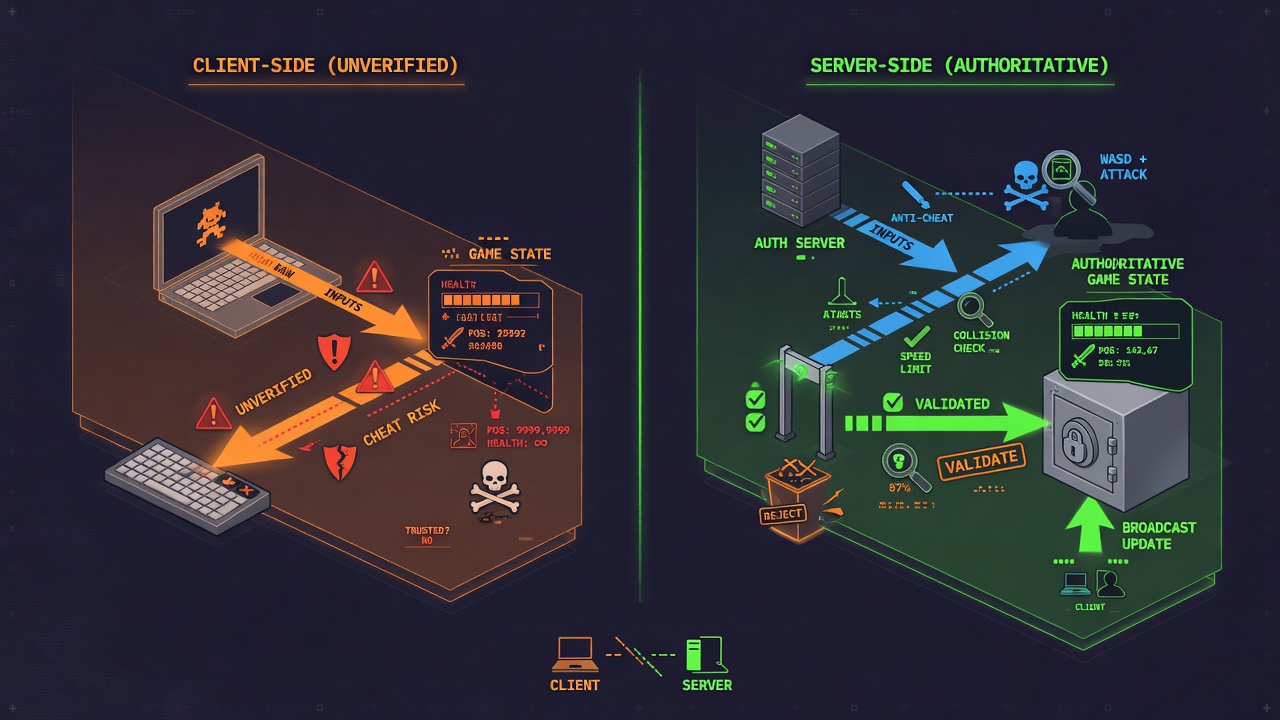
In a client-authoritative setup, the local game client is the ultimate source of truth. When a player moves or fires a weapon, the client immediately updates its local state and tells the server what happened. The server trusts these inputs by default and broadcasts them to all other players. While this makes the gameplay feel incredibly snappy and responsive with zero initial delay, it leaves your game completely vulnerable to exploits, as bad actors can easily manipulate their local client to teleport or fly.
The Server-Authoritative Alternative
A server-authoritative model flips this responsibility. Here, the server is the sole arbiter of truth. When a player presses a movement key, the client sends the input—not the final position—to the server. The server processes this input, validates it against the game’s physics and rules, and then broadcasts the official state back to everyone. This ensures absolute consistency and security, which is why competitive genres like shooters and MOBAs rely heavily on full server authority.
- Client Authority: Offers instant local feedback but risks severe cheating, making it best suited for casual or cooperative games where stakes are low.
- Server Authority: Secures the game state and prevents exploits, but requires robust network engineering to keep the experience feeling fluid.
To prevent the latency of server validation from making the game feel sluggish, Fish-Networking is built server-authoritative by default while offering advanced client prediction. This allows the local client to simulate its own actions instantly, masking the round-trip delay while the server verifies the move in the background. Understanding this balance is key, especially when you begin to secure your game against malicious players. Let's take a closer look at how server-authoritative logic acts as your primary defense against exploits.
The Shield of Truth: Why Server Authority is Non-Negotiable for Security

By establishing the server as the ultimate arbiter, you remove the trust traditionally placed in the client's hands. Instead of allowing a player's machine to declare 'I just teleported 100 meters' or 'I hit that target,' the client merely sends inputs or requests. The server processes these inputs, validates them against the physics and game rules, and only then updates the global simulation.
This centralized validation ensures that invalid or malicious actions are rejected before they can ever affect other players in the session. If a modified client tries to bypass weapon cooldowns, fly across the map, or trigger instant kills, the server-side simulation flags the action as impossible. The server simply ignores the invalid input, snaps the cheating player back to their actual position, and prevents the exploit from ruining the match for everyone else.
Competitive, high-stakes genres like shooters, battle royales, and MOBAs gain the most from this protection. In these environments, fair play is the core product; a single unchecked cheater can destroy player retention and ruin a game's reputation overnight. While casual co-op games might mix authority models to keep development simple, competitive integrity demands strict server authority. Of course, routing every single action through a central server introduces practical challenges, particularly around infrastructure.
Balancing the Scales: Bandwidth, Bills, and Ping
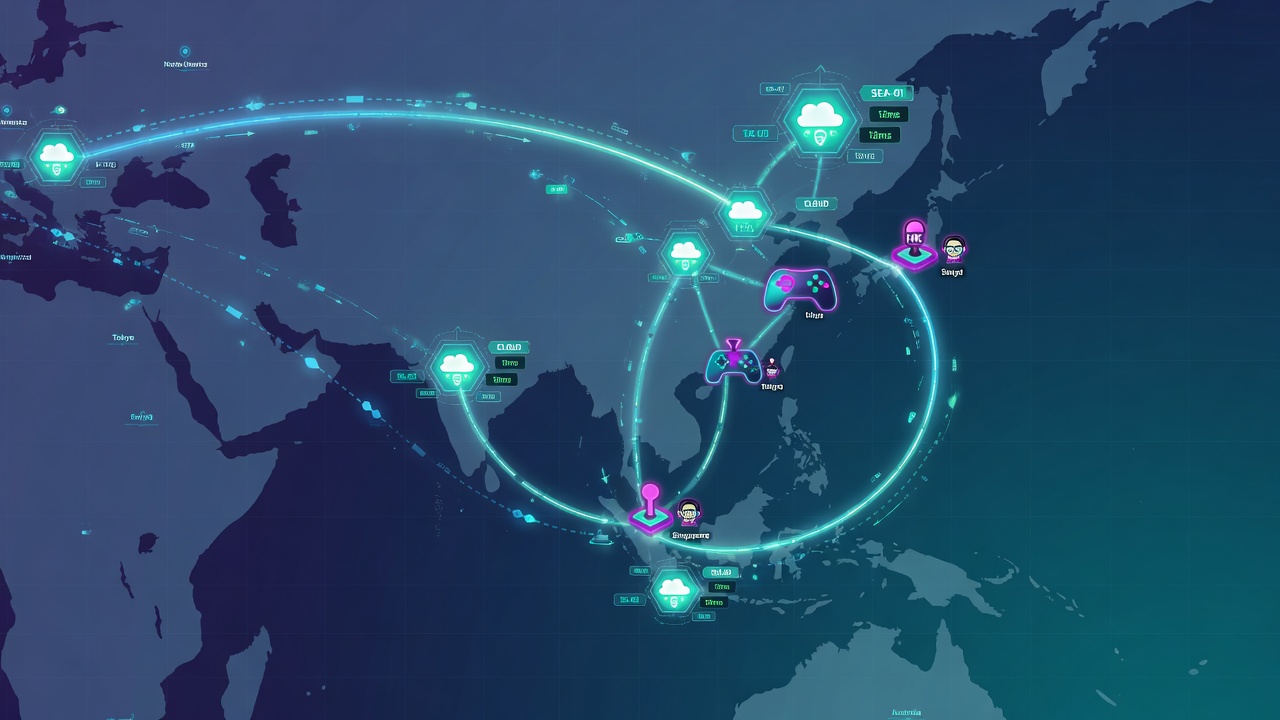
When you shift to a fully server-authoritative model, you aren't just changing code—you are changing your monthly hosting bill. Moving every single action and validation to the server increases costs and network traffic significantly. Since the server must continuously process, verify, and broadcast the state of every player, the sheer volume of data can quickly become a bottleneck. For competitive, high-stakes genres like shooters or MOBAs, this massive overhead is a necessary evil to keep the match fair. However, if you are building a casual co-op game, you might want to mix authority models to keep your overhead under control.
Aside from the financial cost, the biggest threat to a server-authoritative game is physical distance. High latency ruins the illusion of real-time play. To solve this, authoritative servers can be placed strategically in areas with high player density to lower overall latency for all participants. By bringing the simulation closer to the player, you drastically cut down on round-trip time (RTT). For instance, if you are targeting gaming audiences in Asia, hosting your servers in Tokyo or Hong Kong ensures low-latency access for those players.
Of course, spinning up servers in every corner of the globe on day one is a recipe for financial trouble. The smartest approach is to start lean. Launch with just one or two key regions based on your initial playtest and marketing data, then expand your footprint as your player base scales. By combining smart regional hosting with efficient netcode, you can keep the experience responsive without burning through your budget.
But choosing where to host your servers is only half the battle; you also need a networking framework that handles this authority split gracefully without requiring a PhD in network engineering.
Implementing Authority: How Fish-Networking Bridges the Gap
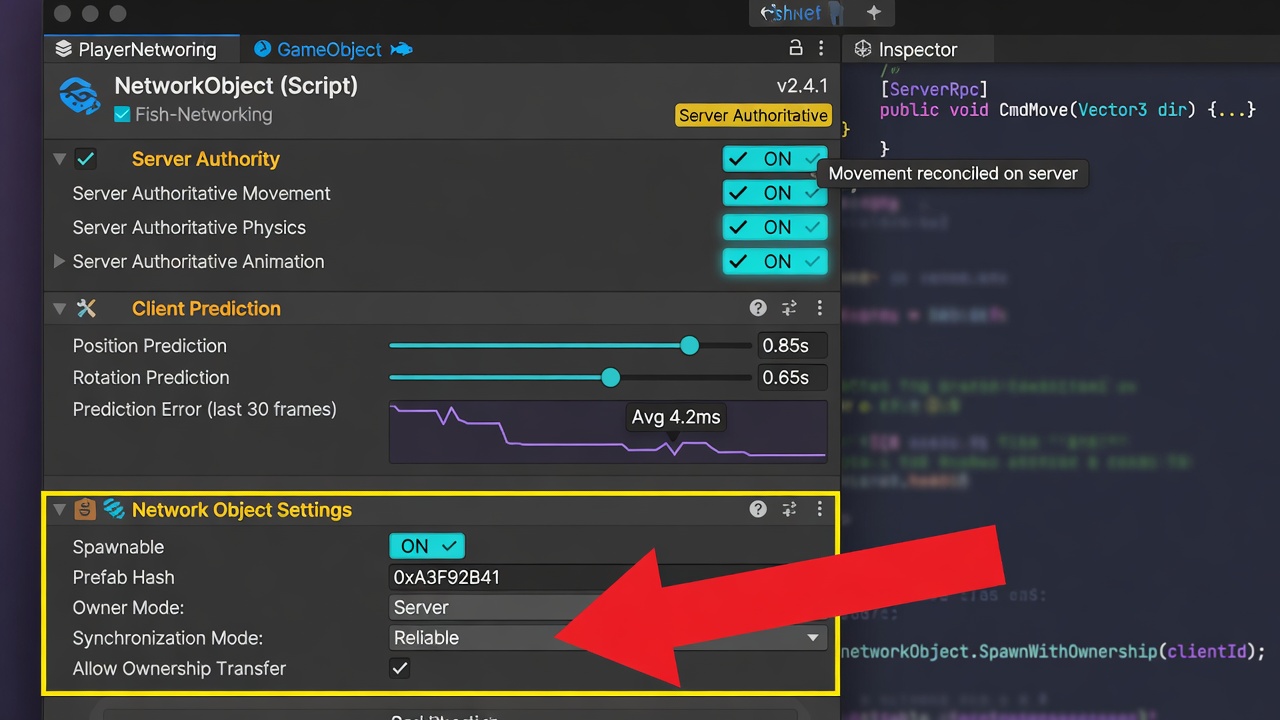
This is where Fish-Networking shines. Built from the ground up to solve the headaches of modern Unity multiplayer, FishNet is server authoritative by design by allowing the use of dedicated servers, while still permitting users to act as both server and client when hosting locally. This architecture ensures that you do not have to fight your netcode to enforce security; the server naturally acts as the absolute gatekeeper of your game state.
But keeping things secure on a dedicated server usually means introducing lag—unless you have a robust client prediction system. Fish-Networking tackles this by supporting client prediction natively. It allows the client to immediately simulate actions, like moving or shooting, giving the player instant feedback while the server silently validates those actions in the background. If the server disagrees, it softly corrects the client. The result is a game that feels like it is running client-authoritatively, but possesses the ironclad security of a dedicated server.
Granular Control with Simple API Calls
What makes FishNet particularly elegant for developers is how easily you can toggle this authority on a per-system basis. You do not have to commit to a single monolithic approach for your entire project. Using straightforward attributes and API calls, you can easily delegate authority:
- ServerRpc sends player inputs securely to the server for validation.
- ObserversRpc broadcasts validated state changes back to all clients.
- TargetRpc sends private updates to specific clients without broadcasting to the entire lobby.
By mixing and matching these authority levels, you can tailor your network architecture to fit your exact gameplay needs. But how do you decide which systems deserve strict server authority and which can run free on the client? It all comes down to your game's genre and target audience.
Matching Authority to Your Genre: When to Lock Down and When to Let Go
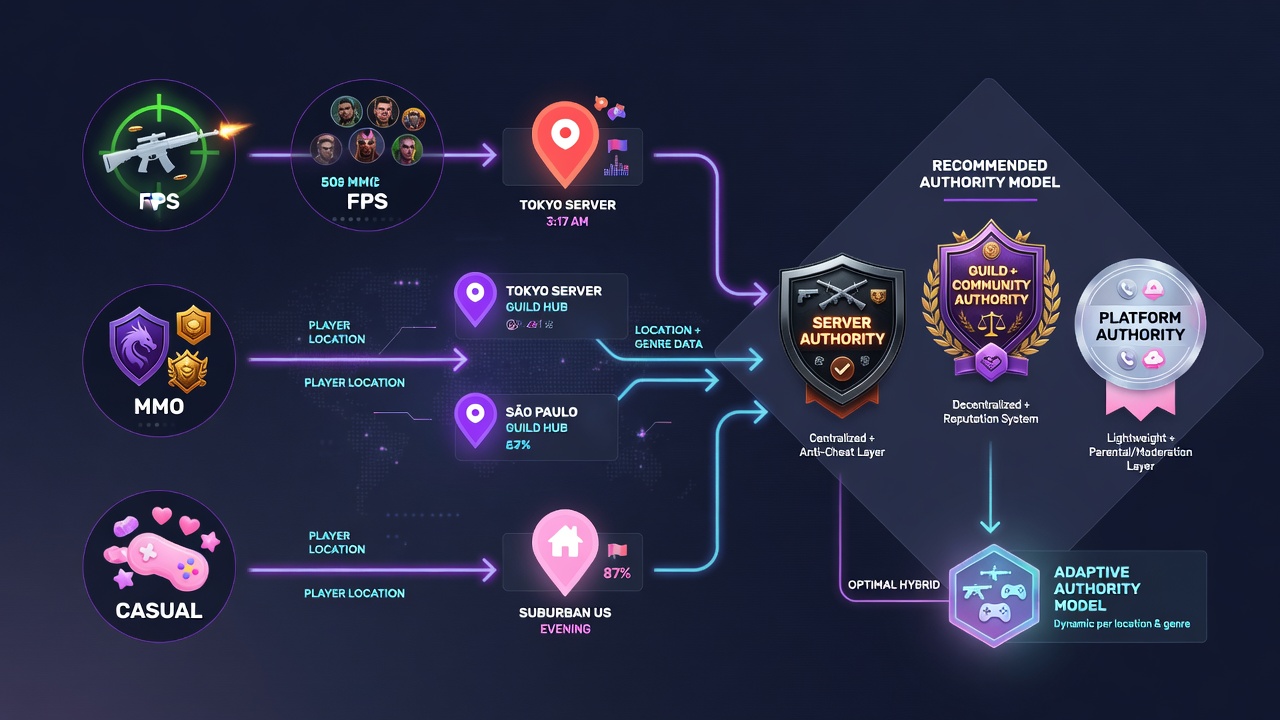
High-stakes, competitive genres like shooters, MOBAs, and battle royales demand uncompromising server authority. In these environments, even a minor exploit can destroy a game's competitive integrity and drive your player base away. Every critical state change—from firing a weapon to activating an ability—must be validated by the server. Fortunately, by utilizing Fish-Networking’s advanced client prediction, you can maintain this ironclad security without subjecting players to sluggish controls or noticeable input lag.
Cooperative and Casual: The Case for Mixed Authority
On the other end of the spectrum, cooperative, PvE, and social games can safely adopt a mixed authority model. If a player modifies their movement speed in a private, low-stakes co-op session, it rarely ruins the experience for others. For these titles, allowing client authority over physics-heavy objects or cosmetic effects can drastically reduce your server workloads. This approach slashes your hosting bills while maintaining a highly responsive feel for non-critical gameplay elements.
Ultimately, smart multi-region hosting bridges the gap, allowing more developers to choose server authority without sacrificing responsiveness. By launching dedicated servers in high-density player hubs and pairing them with Fish-Networking’s robust out-of-the-box netcode, you can deliver the secure, cheat-free, and ultra-responsive multiplayer experience your community expects.
Key Takeaways
Explore our suite of Unity URP and optimization tools at bigfatgames.com to streamline your multiplayer performance and build seamless, lag-free online experiences today.